

What Should A Digital Line Sheet Include For Your Retail Buyers?
Prebooks have always asked both sides of the wholesale relationship to make a bet.
The retailer is betting that the product they commit to months in advance will actually sell when it lands on the floor. The brand is betting that those early commitments are enough to guide production, inventory planning, and fulfillment without ending up wildly over or under bought.
When the model works, everybody wins. The brand gets a demand signal. The retailer gets access to the product they need. Reps have something concrete to sell against. Ops teams can plan around true commitments versus wishful optimism.
Suddenly that bet is feeling a little trickier from both sides.
Retailers are dealing with unpredictable foot traffic, cautious consumers, higher costs, and more pressure to protect cash. Brands are dealing with longer lead times, freight costs, tariffs, inventory risk, and the real pain of buying too much of the wrong thing. So when people say the prebook model is “broken”, what they usually mean is this: the old version of the model puts too much risk in one place, and there’s not enough data being shared to justify a big prebook.
That tension came up in our first episode of Between the Drops, where we sat down with Grant Mahan from Sunski. Grant runs sales operations at Sunski, which means he is planted squarely between sales, ops, systems, fulfillment, forecasting, and retailer support. He is close enough to the sales side to understand what buyers and reps need, and close enough to the ops side to know what happens when a rep writes a check the warehouse can’t cash… figuratively speaking.
When we asked Grant about the prebook conversation, he gave us a great balanced answer. Sunski is not as dependent on prebooks as some apparel or footwear brands, but he understood the retailer’s concern immediately.
“I think really, at the end of the day, it’s using data as much as we can to give the reps and buyers the tools to know and be confident in what they’re buying,” Grant said. He also pointed to the need for “flexibility to send something back to us if it’s not working,” as long as there is a good process around credits, returns, and guardrails.
It’s not no-prebooks, but more informed pre-books and better processes for supporting in-season reorders.
It’s not “just return whatever you didn’t sell”. It’s “let’s figure out a fair process for both sides in case the product doesn’t sell”.
Retailers are not wrong to want less risk
Put yourself in the retailer’s seat for a minute. Better yet, slip their shoes on because we both know they don’t have time to sit.
It is August, and you’re buying for next spring. You are looking at a line that seems promising. The rep is bursting with optimism. The brand has strong photography, good sell sheets, and a confident story around the season. Maybe the product looks great, and let’s hope it is.
But you are still making a decision months before ever giving your customer a vote. Long before you know the answers to these questions:
- What is our walk-in traffic going to look like?
- Is the consumer going to trade up, trade down, or maybe hold off entirely?
- What if my shipments get delayed and compress my season?
- We sell ski gear... What if there’s no snow?
And once that inventory lands, it is your cash sitting on the floor.
If it sells, great. If it doesn’t, you are the one managing markdowns, stale inventory, lower turns, and less open-to-buy for the next opportunity. So when retailers say they want to go lighter on prebooks and replenish more in season, that is not them being difficult.
They are trying to avoid getting stuck with product that looked good six months ago but does not move today.
Brands are not wrong to need commitment
Now flip to the brand side.
A retailer may want to buy lighter up front and replenish later, but the brand still has to decide what to make. They have to place production orders. They have to hit factory minimums. They have to allocate inventory across wholesale, ecommerce, key accounts, distributors, and sometimes marketplaces or corporate orders.
They have to decide how much risk they are willing to carry before they know what demand will really look like.
If they underbuy, retailers are frustrated because the product they need is out of stock right when customers want it. If they overbuy, the brand is sitting on inventory, paying storage fees, tying up cash, and eventually discounting product to clear it out and salvage what they can.
Neither side wants to be the one holding the bag.
That is why the conversation cannot stop at “retailers should commit less” or “brands need better forecasting.” Both statements have some truth, but neither one solves the whole problem.
The better question is: how do brands and retailers share risk in a way that is actually workable?
Data should make the buy feel less like a hunch
A better prebook process starts before the order is placed.
Too many buys are still built around a mix of last year’s numbers, rep intuition, buyer preference, and pressure to commit before the deadline. Those are all meaningful, but they are not enough on their own.
Brands should be helping retailers answer practical questions before they commit:
- What sold through last season?
- What reordered quickly?
- What looked good in sell-in but struggled at sell-through?
- What performed by region?
- What worked in similar doors?
- Which products are proven, and which ones are real bets?
- Where does DTC data support the wholesale story?
- Where are reps hearing consistent feedback from the field?
That kind of information gives the retailer a better chance of placing the right order. It also helps the brand avoid false confidence. A large prebook number is not always a healthy number if it is built on weak assumptions.
Grant mentioned that Sunski uses prebook demand to get a read on what people want, then uses internal models to help fill in the rest of the buying plan. That is the right idea. The prebook should be one signal in a bigger forecasting conversation, but not the singular source of truth.
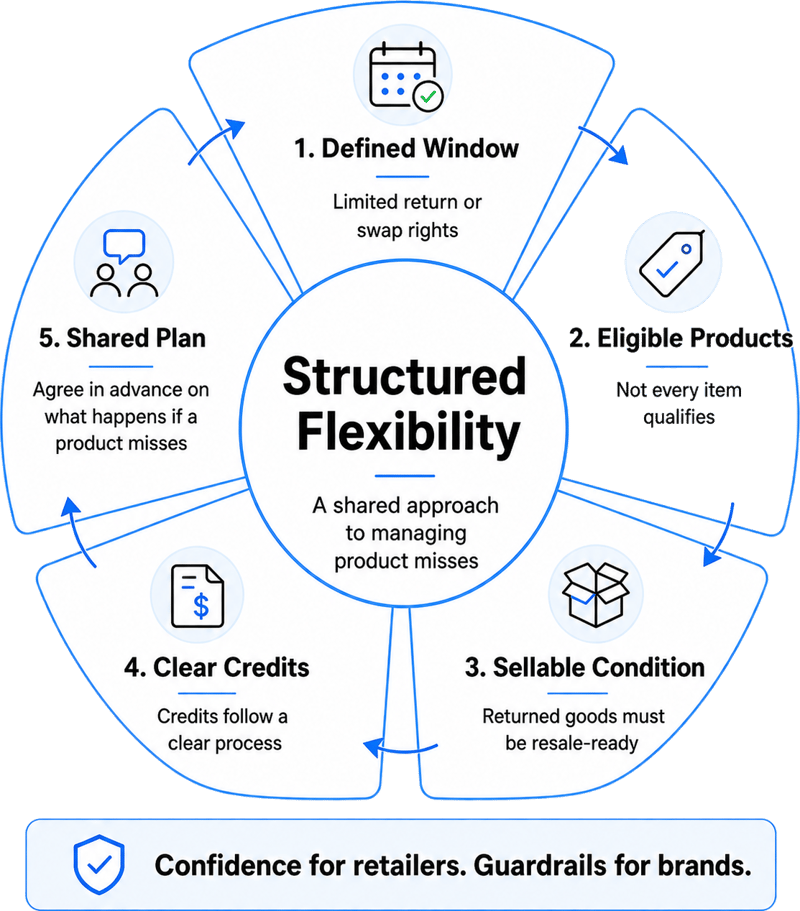
Flexibility is good, but it can’t be uncapped.
The easy answer is to say brands should just let retailers return what does not sell.
That all sounds dandy - until you consider the operational impact.
Returned product has to be shipped back. Someone has to receive it. Someone has to inspect it. Someone has to decide whether it can be resold as new, sold off-price, repaired, repacked, or written off. Credits have to be processed. Inventory has to be adjusted. Accounting has to know what happened. The warehouse has to touch the product again.
Said simply by Grant, “Reverse logistics is expensive.”
That does not mean flexibility is a bad idea. It means flexibility needs structure.
The work continues after the PO
One of the bigger issues with traditional wholesale is that the brand often treats the order as the finish line.
The PO is placed. The product ships. The rep goes on to help the next account, while the retailer goes back to managing the floor.
But if the whole concern around prebooks is sell-through risk, then the most important part happens after the order ships.
Grant gave some perspective on what matters to Sunski: “Sell-through data. Understanding what’s going on instead of just being an email, being like, ‘Hey, this isn’t moving.’ Well, let’s look at the information. There are tools out there.”
Instead of a retailer sending a vague note that something is not moving, both sides should be able to look at what is actually happening. Is the product getting traffic but not converting? Is it buried in the wrong part of the store? Is one color selling and another sitting? Is the issue price, timing, merchandising, assortment, or simply that the product missed?
The answer matters because the fix changes. Sometimes the right move is replenishment. Sometimes it is a swap, a markdown, merchandising support, or accepting that the product missed and learning from it next time. But either way, the PO cannot be the end of the conversation. It has to be the beginning of a shared process for what happens next.
The best model is shared ownership
The future of prebooks probably looks less like a one-time seasonal commitment and more like an ongoing operating rhythm. A little something like this:
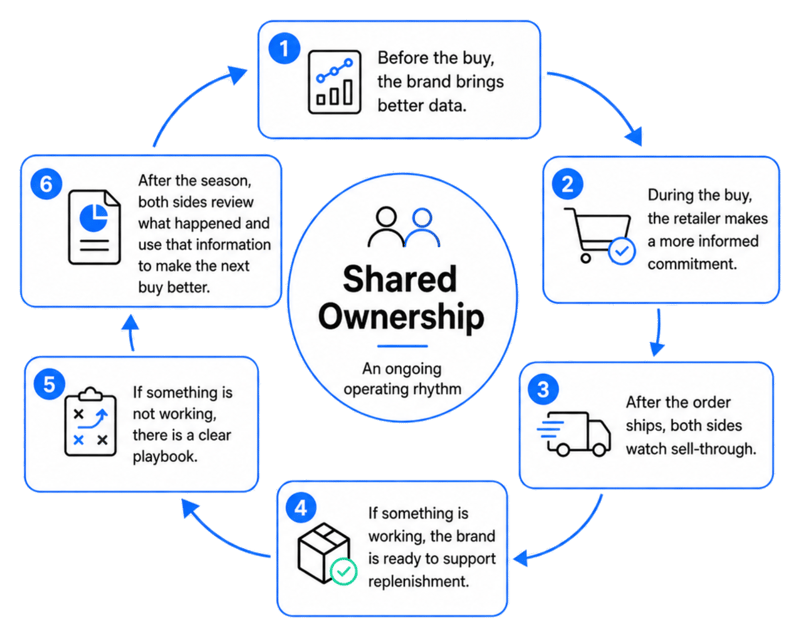
It’s not getting rid of prebooks. It’s not asking retailers to absorb the brunt of the risk. And it’s not asking brands to magically carry every possible inventory scenario. It’s a better exchange.
Better data before the order. Better visibility after the shipment. Better flexibility when consumers don’t behave the way the forecast said they would.
That kind of model only works when both sides stay engaged. Grant put it well when he talked about the role retailers play for Sunski: “They’re your salespeople in the real world that talk to customers about your product.” That is easy to forget when wholesale becomes too transactional.
Retailers are the ones seeing what customers pick up, what they ask about, what they try on, what they buy, and what they ignore. That feedback is valuable, but only if the brand is listening and has a process for acting on it.
That is where this conversation should land.
Brands still need commitments. Retailers still need product to sell. Both sides just need a better way to plan ahead, respond in season, and learn after the fact.
The old trust-fall version of prebooks is showing its age. The next version has to feel less like one side placing a bet and more like both sides managing the outcome together.